


SEO used to be easier to talk about.
Not because it was simple, but because it was contained.
It lived close to marketing, but still felt like its own system.
You had:
- Keywords
- Rankings
- Backlinks
- Technical fixes
- SEO checklist
You could:
- Map the work
- Assign ownership
- Track movement, and
- Explain results in a relatively linear way
If something improved, you knew where to look. If it didn’t, you adjusted.
That version of SEO still exists.
It’s just no longer the full system.

Every business is doing SEO in some form
They are:
- Publishing articles
- Targeting keywords
- Optimizing pages
- Updating content
- Building links
- Tracking positions
From the outside, it looks like discipline.
From the inside, it often feels like volume.
Because the barrier to doing SEO has collapsed.
- You can generate content quickly.
- You can identify keywords instantly.
- You can audit a site in minutes.
Which means activity is no longer a constraint.
And when activity is easy, it becomes difficult to tell the difference between work and progress.

Most SEO efforts are starting to blur
A business publishes consistently, but the message shifts slightly with every post.
- Topics expand without a clear center.
- Keywords are targeted because they exist, not because they connect to something meaningful.
Individually, each piece of content makes sense.
Collectively, it becomes difficult to explain what the site is actually about.
At that point, the issue is not optimization.
It is coherence.
Most businesses are not failing to do SEO
They are doing it constantly.
The problem is that they are doing it without deciding what they are trying to be understood for.
So the system fills the gap.
- Content calendars replace positioning.
- Keyword lists replace strategy.
- Publishing replaces direction.
And because there is output, it feels like something is working.
But output is not the same as understanding.
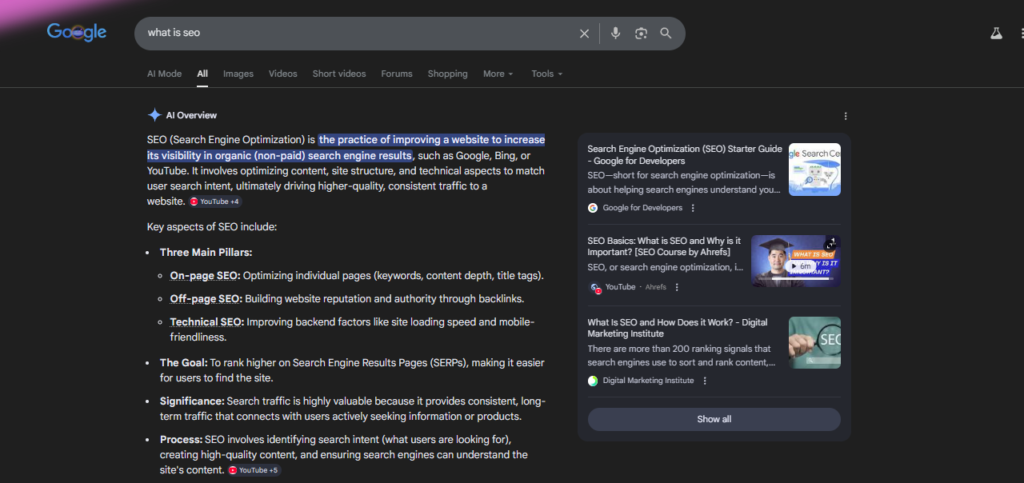
Googling has changed
Search has also changed in ways that are easy to underestimate.
Ranking is no longer the only form of visibility.
- A page can rank and still receive limited traffic.
- A brand can be cited without being visited.
- An answer can be delivered before a click ever happens.
In many cases, the search experience now ends where it used to begin.
Which creates a different kind of pressure.
Not just to appear, but to be selected, extracted, and trusted.
Withouth mentioning that now you are ranking for the AI mention.
Answer Engine Optimization (AEO) is now a thing
This is where newer terms like “AEO” start to appear.
Answer Engine Optimization.
It sounds like a shift, and in some ways it is.
But it is also a reframing of something more fundamental.
The goal is no longer just to be listed among results.
The goal is to become the source systems use when the AIs generate answers.
And that only happens when the information is:
- Clear enough to be understood
- Structured enough to be retrieved
- Consistent enough to be trusted

SEO feels less effective
This is why the current wave of SEO often feels heavier but less effective.
There is more content than ever.
- More pages
- More posts
- More updates
- More coverage
But the advantage of producing more has diminished.
Because most of that content competes at the same level:
- Similar structure
- Similar depth
- Similar intent
When everything looks optimized, differentiation moves elsewhere.
Not to volume.
To clarity.

Making SEO make sense now
SEO, at this point, is less about optimizing pages and more about making a business understandable across systems.
Not just to search engines, but to any system that needs to interpret, summarize, or retrieve information.
That includes:
- Traditional search results
- AI-generated answers
- Voice interfaces
- Aggregated knowledge panels
All of them depend on the same underlying requirement:
Search engines need to understand what you are, what you do, and why it matters.
What if Crawlers do NOT understand your website
When that understanding is weak, SEO becomes reactive.
- New content is created to fill perceived gaps.
- Topics are expanded without reinforcing a core idea.
- Updates are made without changing the underlying message.
The site grows, but the signal does not strengthen.
When Crawlers DO undersntad your website
When that understanding is clear, the behavior changes.
- Content connects.
- Pages reinforce each other.
- Topics build toward something recognizable.
Not because the business is doing more work, but because the work is aligned.
It knows what it is trying to be found for.
And more importantly, what it is not.

What’s SEO?
So the question “what is SEO?” becomes less useful than it appears.
Not because it lacks an answer, but because the answer is no longer stable.
- SEO is not just rankings.
- It is not just traffic.
- It is not just content.
It is the process of making your business legible in systems that decide:
- What gets seen,
- What gets selected, and
- What gets trusted.

Who’s doing SEO?
At this point, every business is participating.
Whether intentionally or not.
The difference is no longer between those who do SEO and those who don’t.
It is between those who are building understanding, and those who are producing activity.
At first, the gap is hard to notice.
Over time, it becomes structural.
And by then, it is no longer a content problem.
It is a clarity problem.